
Types of Air Compressors Explained: Complete Guide for Industrial Applications
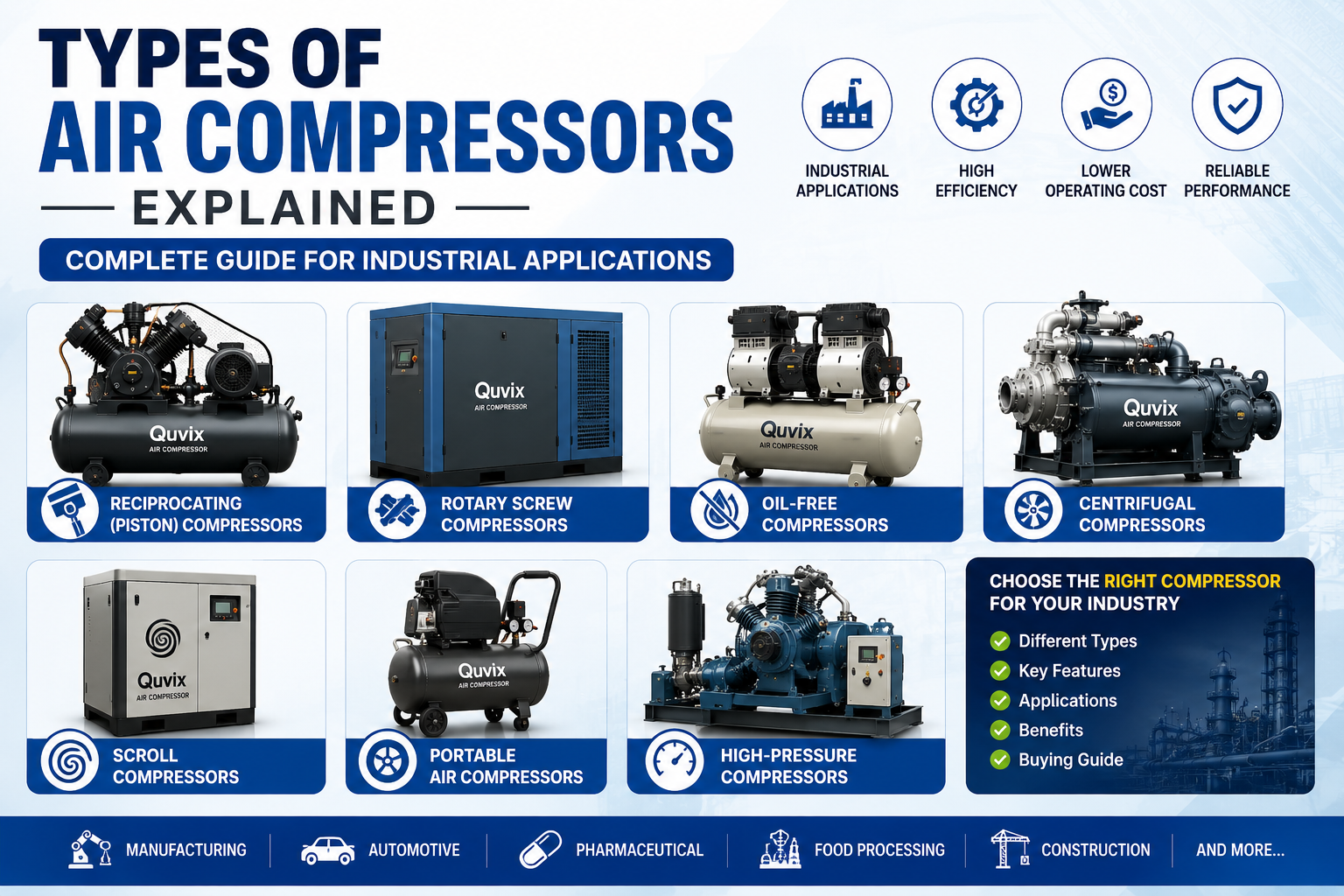
Types of Air Compressors Explained: Complete Guide for Industrial Applications
Air compressors are essential components in modern industrial operations, powering everything from manufacturing equipment and pneumatic tools to packaging systems and automated machinery. Whether you’re running a small workshop or a large-scale production facility, choosing the right type of air compressor can significantly impact efficiency, productivity, and operating costs.
With several compressor technologies available today, selecting the most suitable option can be challenging. Each type offers unique advantages and is designed for specific applications. Factors such as air demand, operating pressure, energy efficiency, and maintenance requirements all play a crucial role in determining the ideal compressor for a particular industry.
In this guide, we’ll explore the different types of air compressors, their working principles, advantages, applications, and key factors to consider before making a purchase decision.
What Is an Air Compressor?
An air compressor is a mechanical device that converts power into compressed air by reducing the volume of atmospheric air. The compressed air produced can then be used to operate tools, machinery, and industrial processes.
Compressed air is often referred to as the “fourth utility” because of its widespread use across industries alongside electricity, water, and natural gas.
How Does an Air Compressor Work?
Air compressors draw atmospheric air into a chamber and compress it using various mechanisms. Once compressed, the air is stored in a tank or supplied directly to the application.
Depending on the compressor type, the compression process may involve:
- Pistons
- Rotating screws
- Scroll mechanisms
- Centrifugal impellers
The choice of technology depends on the required airflow, pressure, and application.
Classification of Air Compressors
Air compressors are broadly classified into two categories:
Positive Displacement Compressors
Positive displacement compressors work by trapping air inside a chamber and reducing its volume to increase pressure.
Examples include:
- Reciprocating Compressors
- Rotary Screw Compressors
- Scroll Compressors
These compressors are commonly used in industrial and commercial applications.
Dynamic Compressors
Dynamic compressors increase air pressure through high-speed rotating impellers.
Examples include:
- Centrifugal Compressors
- Axial Compressors
These are typically used in large-scale industrial facilities requiring high airflow volumes.
Different Types of Air Compressors
Air compressors are available in various designs, each developed to meet specific industrial requirements. Understanding their features and applications can help businesses select the most suitable compressor for their operations.
Reciprocating (Piston) Air Compressors
Reciprocating compressors, also known as piston compressors, are among the oldest and most widely used compressor technologies. These compressors use a piston-cylinder arrangement to compress air and store it in a receiver tank.
They are ideal for applications where compressed air is required intermittently rather than continuously.
Key Advantages
- Lower initial investment
- Simple design
- Easy maintenance
- Portable options available
Common Applications
- Automotive workshops
- Tire inflation stations
- Repair shops
- Small manufacturing units
Best For
Small businesses and applications with low to moderate air demand.
Rotary Screw Air Compressors
Rotary screw compressors are widely used in industrial environments because of their ability to provide continuous compressed air with high efficiency.
These compressors use two interlocking helical rotors that compress air smoothly and efficiently.
Key Advantages
- Continuous operation capability
- Lower noise levels
- High energy efficiency
- Reduced maintenance requirements
Common Applications
- Manufacturing plants
- Textile industries
- Packaging units
- Engineering workshops
Best For
Industries requiring a constant and reliable compressed air supply.
Oil-Free Air Compressors
Oil-free compressors are designed to provide clean and contamination-free air. Unlike conventional compressors, they do not use oil in the compression chamber, making them ideal for industries where air purity is essential.
Key Advantages
- Clean compressed air
- Compliance with strict quality standards
- Reduced contamination risks
- Environmentally friendly operation
Common Applications
- Pharmaceutical industry
- Food and beverage processing
- Electronics manufacturing
- Healthcare facilities
Best For
Applications requiring high air purity and contamination-free operation.
Centrifugal Air Compressors
Centrifugal compressors belong to the dynamic compressor category and are commonly used in large industrial facilities requiring high airflow volumes.
These compressors utilize high-speed rotating impellers to increase air pressure.
Key Advantages
- High airflow capacity
- Excellent energy efficiency
- Continuous operation
- Minimal maintenance
Common Applications
- Petrochemical plants
- Power generation facilities
- Steel industries
- Large manufacturing plants
Best For
Large-scale industrial operations with high compressed air demands.
Scroll Air Compressors
Scroll compressors use two spiral-shaped elements to compress air quietly and efficiently. They are compact and provide oil-free air in many applications.
Key Advantages
- Quiet operation
- Compact design
- Low vibration
- High reliability
Common Applications
- Laboratories
- Dental clinics
- Medical facilities
- Electronics manufacturing
Best For
Applications where low noise and clean air are critical.
Portable Air Compressors
Portable compressors are lightweight and easy to transport, making them suitable for mobile applications and job sites.
Key Advantages
- Easy mobility
- Compact size
- Affordable cost
- User-friendly operation
Common Applications
- Construction sites
- Home workshops
- Vehicle maintenance
- Field operations
Best For
Users requiring flexibility and mobility.
High-Pressure Air Compressors
High-pressure compressors are designed to deliver compressed air at significantly higher pressures than standard industrial compressors.
Key Advantages
- High-pressure output
- Robust construction
- Reliable performance
- Suitable for demanding environments
Common Applications
- PET bottle manufacturing
- Diving equipment
- Defense applications
- Gas filling stations
Best For
Industries requiring high-pressure compressed air systems.
Which Air Compressor Is Right for Your Industry?
Selecting the right type of air compressor depends on several factors, including airflow requirements, operating pressure, energy efficiency, and budget.
For continuous industrial applications, rotary screw compressors are generally the preferred choice. Businesses that require contamination-free air often choose oil-free compressors, while small workshops and automotive garages typically rely on piston compressors.
Understanding your operational requirements is essential to making the right investment and maximizing long-term efficiency.
Industries requiring high-pressure compressed air systems.
1 thought on “Types of Air Compressors Explained: Complete Guide for Industrial Applications”