
Screw Air Compressor vs. Piston Compressor: Which One Is Better in 2026?
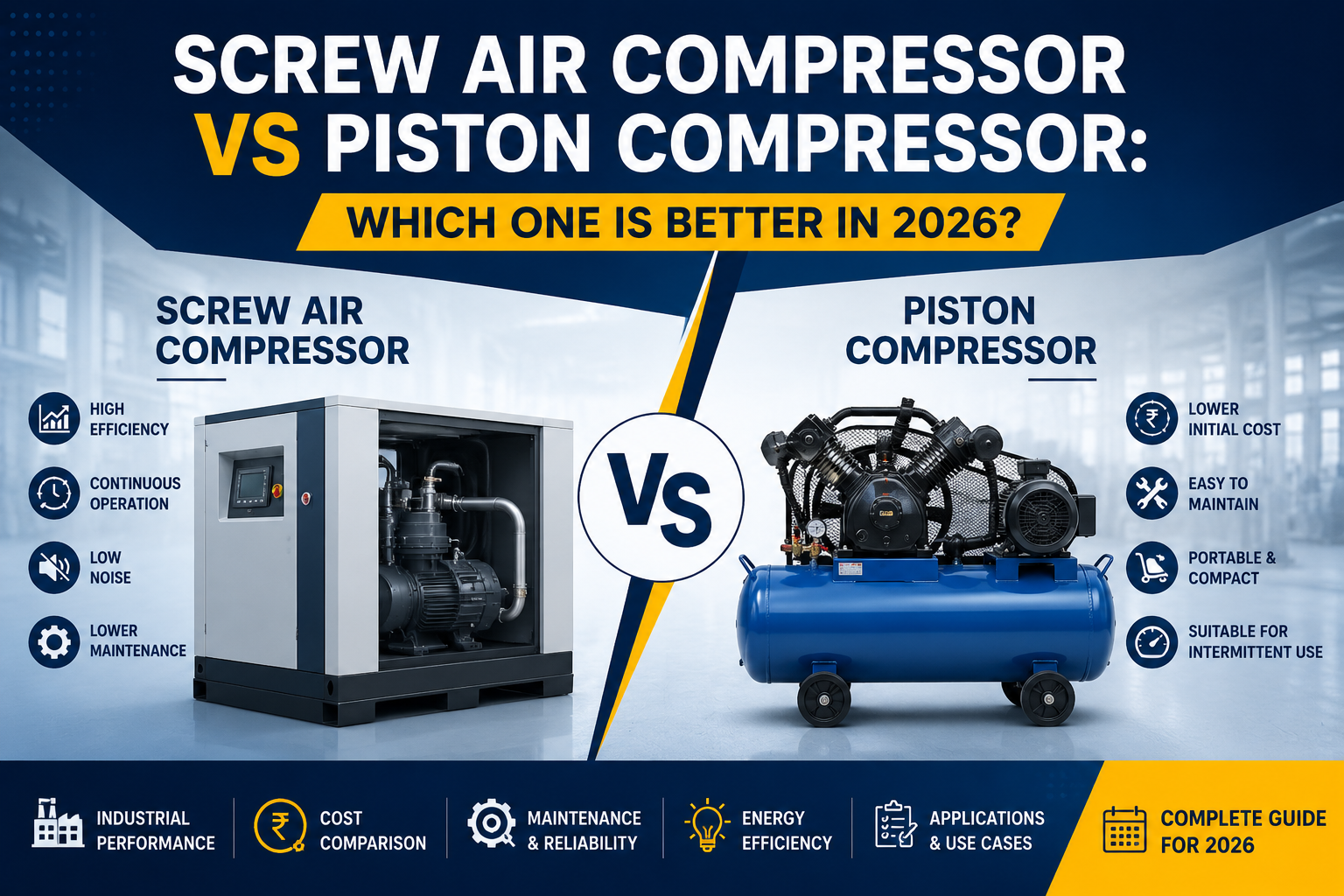
Screw Air Compressor vs Piston Compressor: Which One Is Better in 2026?
Choosing the right air compressor is one of the most important decisions for any business that relies on compressed air systems. Whether you operate a manufacturing unit, automotive workshop, food processing facility, or pharmaceutical plant, selecting the right compressor can significantly impact productivity, operating costs, and overall efficiency.
Among the various types of compressors available today, screw air compressors and piston compressors are the two most widely used options. Both technologies have their own advantages, limitations, and ideal applications. While piston compressors are known for their affordability and simplicity, screw compressors are preferred for continuous operation and higher efficiency.
So, which one is better in 2026?
The answer depends on factors such as air demand, operating hours, maintenance requirements, and budget. Understanding the difference between these two compressor technologies can help businesses make an informed investment and maximize long-term value.
In this guide, we’ll compare screw air compressors and piston compressors based on performance, energy efficiency, maintenance, operating costs, and industrial applications to help you determine which option best suits your needs.
According to Atlas Copco, compressed air is often referred to as the fourth utility in modern industry because of its widespread use across manufacturing and engineering applications.
Understanding Screw Air Compressors
Screw air compressors are among the most commonly used industrial compressors due to their ability to provide a continuous supply of compressed air. These compressors use two interlocking helical rotors that rotate together to compress air efficiently.
Unlike piston compressors, screw compressors are designed for continuous-duty applications and can operate for extended periods without overheating. Their efficient design makes them ideal for industries that require a constant and reliable air supply.
How Does a Screw Air Compressor Work?
A screw compressor works by drawing atmospheric air into a compression chamber containing two rotating screws or rotors. As the rotors turn, the air gets compressed and delivered to the system at the desired pressure.
This process ensures:
- Continuous airflow
- Reduced vibration
- Low noise levels
- High energy efficiency
Advantages of Screw Air Compressors
High Energy Efficiency
Modern rotary screw compressors consume less energy compared to traditional compressors, making them a cost-effective solution for industrial operations.
Continuous Operation
Screw compressors are specifically designed for 24/7 operation and are ideal for industries with constant compressed air requirements.
Lower Noise Levels
These compressors operate more quietly than piston compressors, making them suitable for indoor and enclosed environments.
Reduced Maintenance
With fewer moving components and smoother operation, screw compressors generally require less maintenance and experience fewer breakdowns.
Longer Service Life
When properly maintained, rotary screw compressors can deliver reliable performance for many years.
Common Applications of Screw Air Compressors
Screw air compressors are widely used in:
- Manufacturing industries
- Automotive plants
- Food and beverage processing
- Pharmaceutical facilities
- Textile industries
- Packaging plants
- Engineering workshops
Understanding Piston Compressors
Piston compressors, also known as reciprocating compressors, have been used for decades and remain a popular choice for small businesses and intermittent applications. These compressors use a piston and cylinder arrangement to compress air and store it in a receiver tank.
Piston compressors are relatively simple in design and offer an economical solution for operations that do not require a continuous air supply.
How Does a Piston Compressor Work?
A piston compressor works by using a crankshaft-driven piston to draw air into a cylinder. The piston then compresses the air and delivers it to the storage tank.
This process repeats continuously based on air demand.
Advantages of Piston Compressors
Lower Initial Investment
Piston compressors are generally more affordable, making them suitable for small businesses and workshops.
Simple Design
Their simple construction makes servicing and repairs relatively easy.
Portable Options Available
Many piston compressors are compact and portable, allowing them to be moved between job sites.
Suitable for Intermittent Use
They are ideal for applications where compressed air is needed only occasionally rather than continuously.
Common Applications of Piston Compressors
Piston compressors are commonly used in:
- Automotive garages
- Repair shops
- Small manufacturing units
- Construction sites
- Tire inflation stations
- DIY workshops
In the next section, we’ll compare screw air compressors and piston compressors based on efficiency, maintenance, operating costs, noise levels, lifespan, and industrial applications to determine which compressor is better in 2026.
Screw Air Compressor vs Piston Compressor: Key Differences
Although both screw compressors and piston compressors are designed to provide compressed air, their performance, efficiency, and suitability vary considerably. Understanding these differences can help businesses choose the right compressor based on their operational requirements.
Working Principle
One of the biggest differences between these two technologies lies in how they compress air.
A screw air compressor uses two interlocking rotors that rotate continuously to compress air. This mechanism allows the compressor to provide a smooth and uninterrupted flow of compressed air.
On the other hand, a piston compressor uses a crankshaft and piston assembly to compress air inside a cylinder. Since this process is cyclic, the airflow produced is intermittent rather than continuous.
Winner: Screw Air Compressor
For applications requiring a steady and continuous supply of compressed air, screw compressors offer superior performance.
Energy Efficiency
Energy consumption represents one of the largest expenses associated with compressed air systems. Therefore, efficiency plays a crucial role in determining long-term operating costs.
Modern screw compressors are equipped with advanced technologies such as Variable Speed Drive (VSD), intelligent controllers, and optimized compression mechanisms. These features help reduce electricity consumption and improve overall efficiency.
Piston compressors, while effective for smaller operations, generally consume more energy when used continuously.
Winner: Screw Air Compressor
Businesses with high air demand can benefit significantly from the energy-saving capabilities of screw compressors.
Initial Cost
When comparing purchase prices, piston compressors are usually more affordable. Their simple design and lower manufacturing costs make them a cost-effective solution for small businesses and occasional use.
Screw compressors involve a higher initial investment due to their advanced technology and industrial-grade construction.
Winner: Piston Compressor
For businesses with limited budgets and lower compressed air requirements, piston compressors offer better affordability.
Maintenance Requirements
Maintenance is another important factor to consider when selecting an air compressor.
Screw compressors have fewer moving parts and operate smoothly, which reduces wear and tear. As a result, they generally require less frequent maintenance and experience fewer breakdowns.
Piston compressors contain several moving components that are subjected to continuous mechanical stress. This often results in higher maintenance requirements and more frequent servicing.
Winner: Screw Air Compressor
Lower maintenance requirements translate into reduced downtime and improved productivity.
Noise Levels
Noise can become a concern in indoor environments and workplaces where operators are exposed to compressor systems throughout the day.
Screw air compressors are known for their quiet operation and lower vibration levels. Many models are equipped with soundproof enclosures that further minimize noise.
Piston compressors tend to produce higher noise levels because of the repetitive movement of pistons and valves.
Winner: Screw Air Compressor
For offices, factories, and indoor installations, screw compressors provide a quieter and more comfortable working environment.
Lifespan
The durability of a compressor depends largely on operating conditions and maintenance practices.
Screw compressors are engineered for continuous-duty applications and can deliver reliable performance for 15 to 20 years with proper maintenance.
Piston compressors generally have a shorter lifespan and may require component replacements more frequently, especially when operated continuously.
Winner: Screw Air Compressor
For long-term reliability and durability, screw compressors offer a clear advantage.
Operating Costs
While piston compressors are cheaper to purchase, their operating costs can be higher over time due to increased energy consumption and maintenance expenses.
Screw compressors, despite their higher upfront cost, provide lower operating costs and better efficiency throughout their service life.
Winner: Screw Air Compressor
For businesses focused on long-term savings, screw compressors offer greater value
Continuous Operation Capability
One of the most significant advantages of screw compressors is their ability to operate continuously without overheating.
Piston compressors are better suited for intermittent use and typically require rest periods between cycles.
Winner: Screw Air Compressor
Industries that require 24/7 compressed air supply should strongly consider screw compressors.
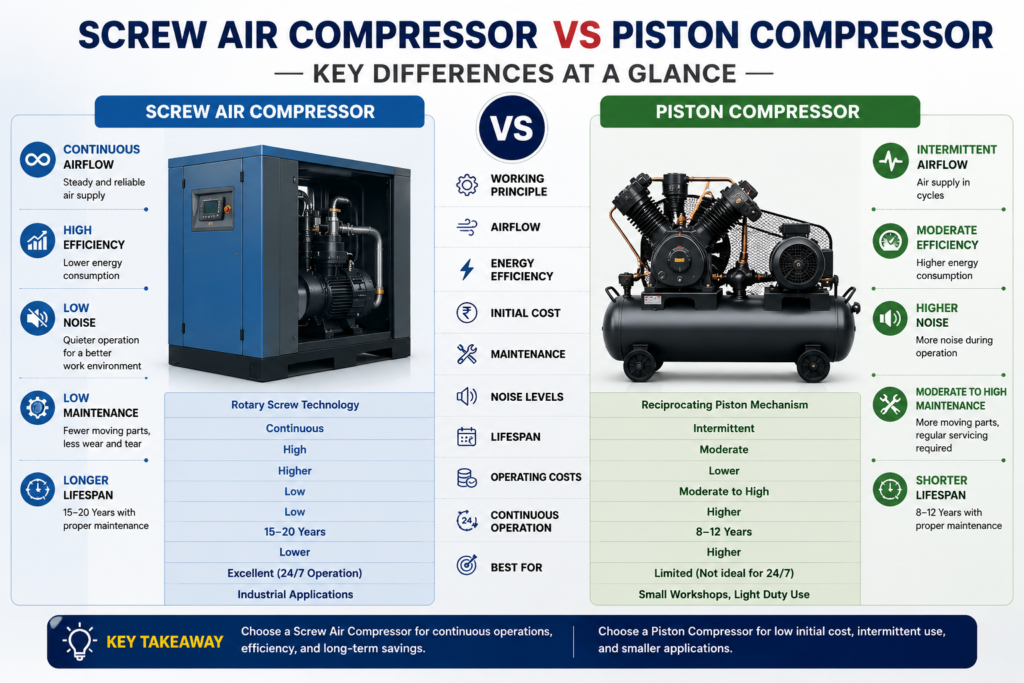
Comparison Table: Screw Air Compressor vs Piston Compressor
| Parameter | Screw Air Compressor | Piston Compressor |
|---|---|---|
| Working Principle | Rotary Screw Technology | Reciprocating Piston Mechanism |
| Airflow | Continuous | Intermittent |
| Energy Efficiency | High | Moderate |
| Initial Cost | Higher | Lower |
| Maintenance | Low | Moderate to High |
| Noise Levels | Low | Higher |
| Lifespan | 15–20 Years | 8–12 Years |
| Operating Costs | Lower | Higher |
| Continuous Operation | Excellent | Limited |
| Best For | Industrial Applications | Small Workshops |
Which Compressor Should You Choose?
If your business requires continuous operation, high efficiency, lower operating costs, and long-term reliability, a screw air compressor is the better choice.
However, if your compressed air demand is low and budget is a primary concern, a piston compressor remains a practical and economical solution.
Ultimately, the right choice depends on your application, production requirements, and long-term business goals.