
Refrigerated Air Dryer vs Desiccant Air Dryer: Which One Should You Choose?
Refrigerated Air Dryer vs Desiccant Air Dryer: Which One Should You Choose?
Compressed air is an essential utility in modern industrial operations, but the air produced by an air compressor contains moisture, oil vapor, and contaminants that can damage equipment and reduce product quality. To ensure clean and dry compressed air, industries rely on air dryers as an integral part of their compressed air systems.
Among the most commonly used air dryers are refrigerated air dryers and desiccant air dryers. While both are designed to remove moisture from compressed air, they operate using different technologies and are suitable for different industrial applications.
Selecting the wrong air dryer can lead to corrosion, equipment failures, poor product quality, and unnecessary operating costs. Understanding the differences between these two air dryer technologies is essential for choosing the right solution for your business.
In this guide, we’ll compare refrigerated air dryers and desiccant air dryers based on their working principles, performance, energy efficiency, maintenance requirements, operating costs, and industrial applications.
According to Atlas Copco, proper air treatment is essential for protecting compressed air systems, improving energy efficiency, and extending equipment life.
What Is a Refrigerated Air Dryer?
A refrigerated air dryer removes moisture from compressed air by cooling it to a low temperature. As the air cools, water vapor condenses into liquid droplets, which are then separated and drained from the system.
Most refrigerated air dryers achieve a pressure dew point of approximately 3°C (37°F), making them suitable for the majority of industrial applications where extremely dry air is not required.
Refrigerated air dryers are widely used because they offer reliable performance, low operating costs, and simple maintenance.
How Does a Refrigerated Air Dryer Work?
A refrigerated air dryer follows a simple cooling process:
- Warm compressed air enters the dryer.
- A refrigeration system cools the air.
- Moisture condenses into water.
- A moisture separator removes the condensed water.
- Dry compressed air leaves the dryer and enters the compressed air system.
This continuous process helps protect pipelines, pneumatic tools, and production equipment from moisture-related damage.
Advantages of Refrigerated Air Dryers
Lower Operating Costs
Refrigerated air dryers consume relatively little energy compared to desiccant dryers, making them an economical choice for many industries.
Easy Maintenance
Their simple design reduces maintenance requirements and lowers servicing costs.
Reliable Performance
These dryers provide consistent moisture removal under normal operating conditions.
Long Service Life
With routine maintenance, refrigerated air dryers deliver reliable performance for many years.
Common Applications of Refrigerated Air Dryers
Refrigerated air dryers are commonly used in:
- Manufacturing plants
- Automotive workshops
- Engineering industries
- Packaging facilities
- CNC machining
- General industrial applications
What Is a Desiccant Air Dryer?
A desiccant air dryer removes moisture by passing compressed air through a chamber filled with moisture-absorbing materials known as desiccants.
Unlike refrigerated dryers, desiccant dryers do not rely on cooling. Instead, they chemically absorb water vapor, allowing them to achieve extremely low dew points.
This makes desiccant dryers the preferred choice for industries requiring exceptionally dry compressed air.
How Does a Desiccant Air Dryer Work?
A typical desiccant dryer consists of two drying towers.
While one tower dries the compressed air, the second tower regenerates the saturated desiccant material. The towers automatically alternate during operation to provide a continuous supply of dry air.
This dual-tower design ensures uninterrupted operation even in demanding industrial environments.
Advantages of Desiccant Air Dryers
Ultra-Low Dew Point
Desiccant dryers can achieve pressure dew points as low as -40°C to -70°C, making them ideal for critical applications.
Superior Moisture Removal
They remove nearly all moisture from compressed air, even in humid environments.
Suitable for Extreme Conditions
These dryers perform reliably in cold climates where refrigerated dryers may not provide sufficient drying.
Excellent Air Quality
They help protect sensitive manufacturing processes from moisture contamination.
Common Applications of Desiccant Air Dryers
Desiccant air dryers are widely used in:
- Pharmaceutical manufacturing
- Food and beverage processing
- Electronics manufacturing
- Chemical industries
- Medical facilities
- Semiconductor production
- Cleanroom environments
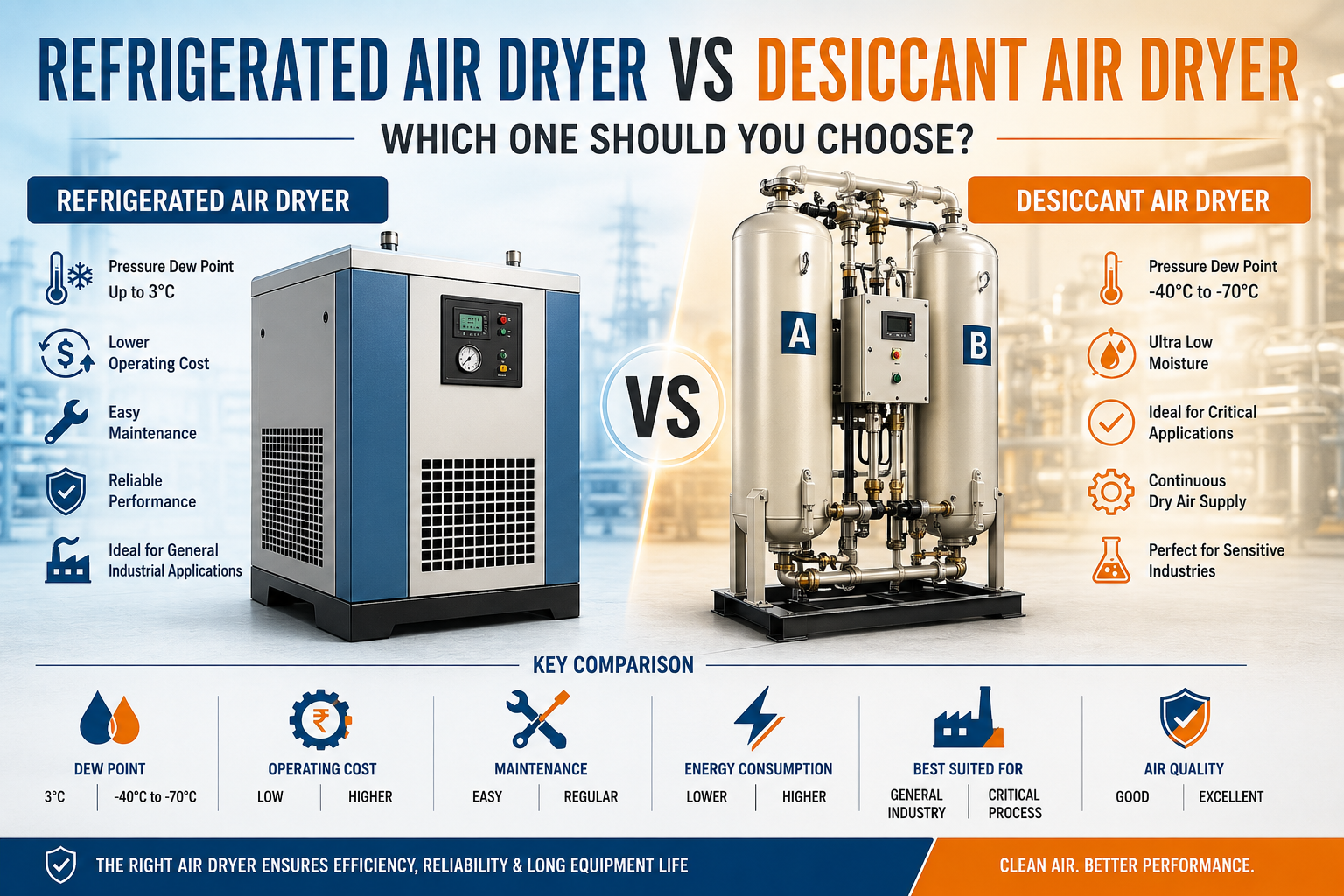
Refrigerated Air Dryer vs Desiccant Air Dryer: Key Differences
Although both refrigerated air dryers and desiccant air dryers are designed to remove moisture from compressed air, they differ significantly in terms of drying performance, operating costs, maintenance requirements, and industrial applications. Understanding these differences helps businesses select the most suitable air treatment solution.
Dew Point
A refrigerated air dryer typically provides a pressure dew point of around 3°C (37°F), which is sufficient for most general industrial applications.
A desiccant air dryer can achieve an extremely low pressure dew point of -40°C to -70°C, making it ideal for industries that require ultra-dry compressed air.
Air Quality
Refrigerated air dryers effectively remove moisture but are not designed for applications requiring extremely dry air.
Desiccant air dryers provide exceptionally dry compressed air, protecting sensitive equipment and preventing moisture-related contamination.
Energy Efficiency
Refrigerated air dryers generally consume less energy because they use a refrigeration cycle to remove moisture.
Desiccant air dryers require additional energy during the regeneration process, resulting in higher energy consumption.
Initial Investment
Refrigerated air dryers usually have a lower purchase price, making them an economical choice for standard industrial applications.
Desiccant air dryers involve a higher initial investment due to their advanced drying technology and dual-tower design.
Maintenance Requirements
Refrigerated air dryers require relatively simple maintenance, including condenser cleaning, drain inspection, and periodic servicing.
Desiccant air dryers require additional maintenance, such as replacing desiccant material, servicing valves, and monitoring the regeneration system.
Operating Costs
Because of their lower energy consumption and simpler maintenance, refrigerated air dryers generally have lower operating costs.
Desiccant air dryers typically involve higher operating costs but provide superior moisture removal for critical applications.
Best Industrial Applications
Refrigerated Air Dryers
Best suited for:
- Manufacturing
- Automotive
- Engineering
- Packaging
- CNC Machining
- General Industrial Plants
Desiccant Air Dryers
Ideal for:
- Pharmaceutical Manufacturing
- Food & Beverage Processing
- Electronics Manufacturing
- Chemical Industry
- Medical Facilities
- Cleanrooms
- Semiconductor Production
Comparison Table
| Parameter | Refrigerated Air Dryer | Desiccant Air Dryer |
|---|---|---|
| Working Principle | Cooling and Condensation | Moisture Absorption Using Desiccant |
| Pressure Dew Point | Around 3°C | -40°C to -70°C |
| Air Quality | Good | Excellent |
| Energy Consumption | Lower | Higher |
| Initial Cost | Lower | Higher |
| Maintenance | Low | Moderate to High |
| Operating Cost | Lower | Higher |
| Moisture Removal | Standard | Ultra-Low Moisture |
| Best Applications | General Industrial Use | Critical & Sensitive Industries |
Which Air Dryer Should You Choose?
Choosing the right air dryer depends on your industry’s air quality requirements, operating environment, and budget.
Choose a Refrigerated Air Dryer if you need:
- Cost-effective moisture removal
- Lower operating costs
- Easy maintenance
- General industrial applications
- Reliable everyday performance
Choose a Desiccant Air Dryer if you require:
- Ultra-dry compressed air
- Extremely low dew points
- Cleanroom compatibility
- Pharmaceutical or food-grade air quality
- Protection against moisture in cold environments
Selecting the correct air dryer not only improves system performance but also reduces maintenance costs and extends the life of downstream equipment.
Conclusion
Both refrigerated air dryers and desiccant air dryers play an essential role in maintaining the quality of compressed air systems. Refrigerated air dryers are the preferred choice for most manufacturing and engineering applications due to their affordability and energy efficiency.
On the other hand, desiccant air dryers are the best option for industries where even small amounts of moisture can affect product quality or damage equipment. By evaluating your operating conditions, required dew point, and maintenance budget, you can choose the air dryer that delivers the best long-term value for your business.
When comparing Refrigerated Air Dryer vs Desiccant Air Dryer, the best choice depends on your required dew point, operating environment, and air quality requirements. Selecting the right air dryer will improve efficiency, protect equipment, and reduce long-term operating costs.